Getting To Fascism
Fascism, as a formal ideology, is the rejection of reason in favor of will, the belief that social hierarchy is both natural and desirable, and the organization of social, political, and economic life around a strongman. But there are many ways to get there, most of which seem innocuous, even virtuous, at first.
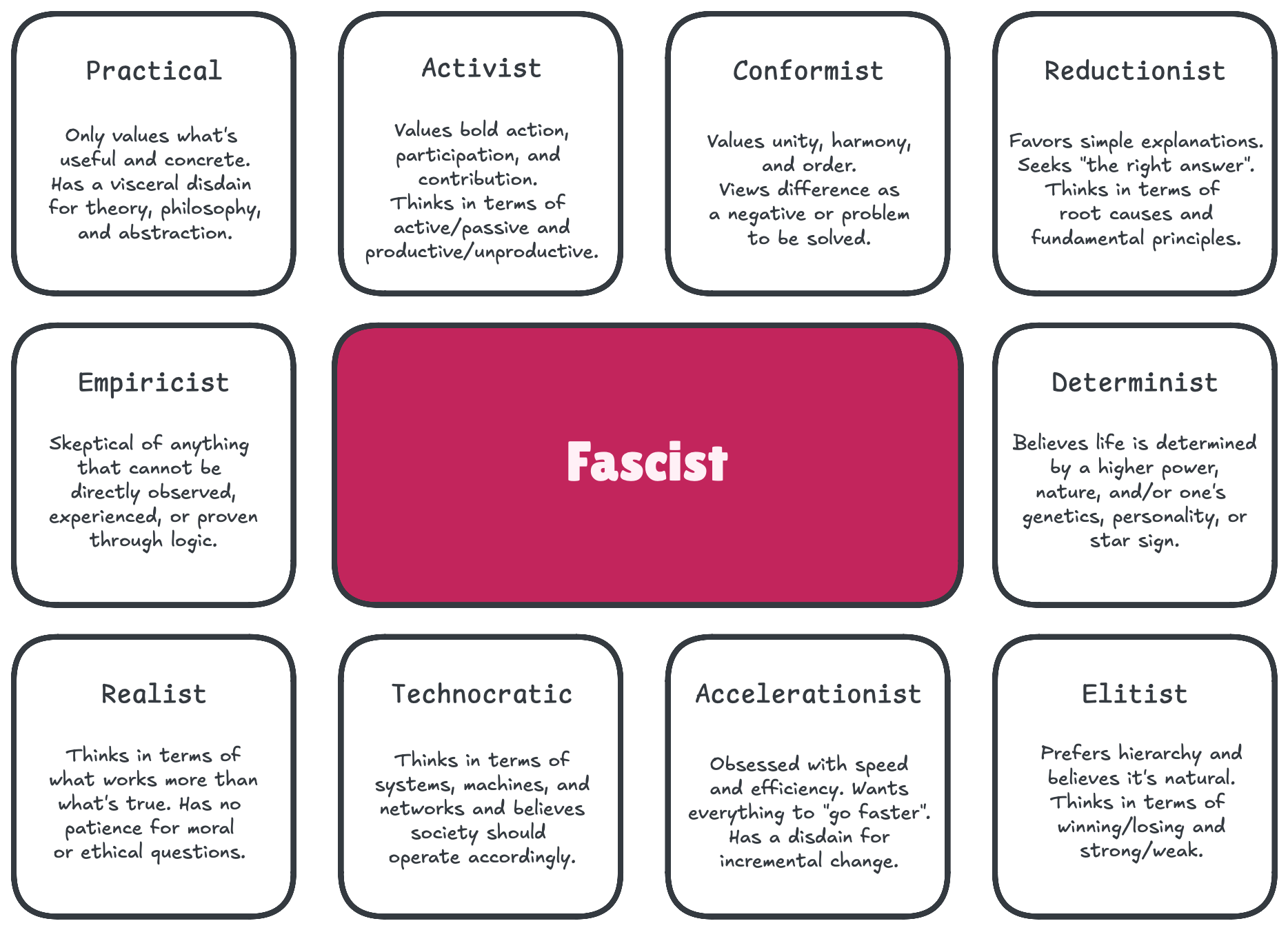
It’s no accident many of the adjectives here also describe engineers, given that authoritarian societies, fascist or otherwise, tend to be dominated them and their values. That’s something I think about a lot.
Managing my health has given me an appreciation for the engineering mindset; and building my own software (or trying to) has been deeply healing by offering a sense of control. But I’m unapologetically anti-technocratic. And I’m disturbed by the extent to which many in the social sciences, and even the humanities, increasingly aren't.
Perhaps all of this sounds a little academic. Don’t we need to do something? Yes. But we also need to know what we're fighting. And it isn't just "fascism".
Further Reading
- Abby Covert has a useful framework for thinking about values: balanced, undervalued, and overvalued. I love that. Perhaps what I’ve identified here are continuums, rather than discrete qualities. Her essay, “Turning Values Into Missions”, is something I plan to re-read while developing my ideas further. https://abbycovert.com/writing/values-to-missions/
- Geoff Mulgan wrote an excellent piece on why bureaucrats and politicians should learn how to approach collective action problems like an engineer. That said, I'm a little disappointed by how much he's been advocating for an “engineering society" lately. I prefer his book Another World Is Possible: Reigniting Social and Political Imagination, which offers a much bolder vision of how to design the future. https://geoffmulgan.substack.com/p/in-praise-of-plumbing
- Corporate media has been shocked by the tech industry’s shift rightward, but there's nothing to be surprised about. Richard Barbrook and Andy Cameron’s 1995 essay “The California Ideology”, Peter Thiel's 2010 talk at Libertopia (and just about every one of his essays, talks, and interviews), and the long history of people trying to replace politics with technology will tell you why. I enjoyed Nathan Schneider's recent piece on this point: https://www.techpolicy.press/thirty-years-on-the-californian-ideology-is-alive-and-well/.